

They support storage labeling systems in kitchens, closets, offices, and garages, helping homeowners reduce clutter and improve accessibility.
You open a cabinet. see five identical containers. check each one. Sugar? Salt? Flour? That daily friction adds up.
This is the problem. Most homes are not messy because of lack of space. They are disorganized because items are not clearly identified. When things are not labeled, people waste time searching, duplicate purchases, and create visual chaos.
Label makers for kitchen organization and storage labeling fix this at the root. They provide a clear system. Every jar, box, or bin has a defined purpose. You know where items belong. Other family members know too.
According to a 2023 National Association of Productivity and Organizing Professionals (NAPO) survey, over 54% of homeowners report stress caused by household clutter. Clear labeling is one of the simplest tools professionals use to reduce that stress.
This guide explains exactly how label makers help you organize your home efficiently, where to use them, and how to create a storage labeling system that works long term.
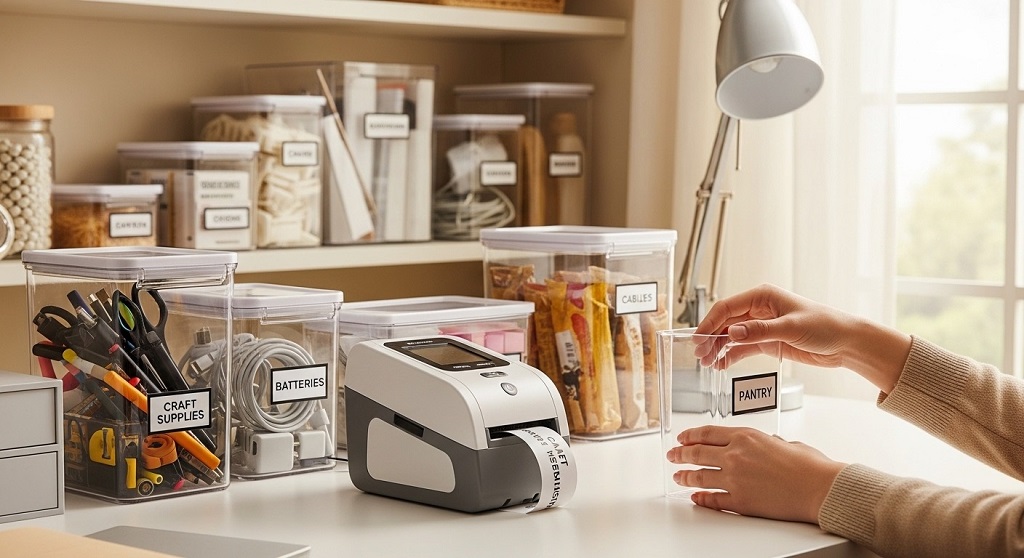
Why Is Storage Labeling Important for Home Organization?
Storage labeling improves visibility, reduces search time, and creates accountability within shared spaces.
Here is the core issue: without labels, systems fail. You may organize once, but over time items drift back into random spaces.
The Problem: Clutter Returns Quickly
You clean your pantry. You group similar products. It looks neat for a week. Then someone places rice in the pasta section. Snacks mix with baking supplies. The structure collapses.
The Agitation: Time and Money Are Lost
- You buy items you already have.
- You waste minutes daily searching for tools or spices.
- Kids cannot find school supplies.
- Guests cannot help because they do not know where things belong.
A UCLA Center on Everyday Lives of Families study found that households spend significant time managing belongings, especially in high-density storage areas like kitchens and garages.
The Solution: Clear Labeling Systems
When you apply consistent storage labeling:
- Every item has a fixed category.
- Visual cues replace memory.
- Maintenance becomes automatic.
- Family members follow the system without instruction.
Label makers for kitchen cabinets, food containers, storage bins, and shelving units turn invisible structure into visible structure.
How Do Label Makers for Kitchen Organization Improve Efficiency?
Label makers for kitchen use create defined zones, prevent food waste, and speed up cooking processes.
The kitchen is the most used space in most homes. It is also the most chaotic.
1. Clear Pantry Categorization
Using a label maker, you can identify:
- Grains
- Baking supplies
- Spices
- Snacks
- Breakfast items
- Canned goods
This transforms shelves into a functional system rather than stacked products.
2. Reduce Food Waste
When containers are labeled with product names and expiration dates:
- You rotate stock properly.
- You avoid duplicate purchases.
- You reduce expired goods.
The USDA estimates that 30–40% of the U.S. food supply is wasted annually. While labeling alone does not solve this, clear pantry identification helps reduce avoidable spoilage at the household level.
3. Speed Up Meal Preparation
During cooking, you need fast access. If spices are labeled clearly and arranged alphabetically or by cuisine, preparation time decreases.
| Before Labeling | After Labeling |
|---|---|
| Search 30–60 seconds per spice | Instant visual identification |
| Cluttered shelves | Defined zones |
| Frequent duplicates | Controlled inventory |
The efficiency gain may seem small per task. Over months, it becomes significant.
How Can Label Makers Improve Closet and Storage Room Organization?
Label makers create structure in closets and storage rooms by defining seasonal, personal, and utility categories.
Closets fail because they lack clear divisions. Storage rooms fail because boxes look identical.
Closet Labeling Strategies
- Seasonal clothing bins (Winter, Summer, Festive)
- Shoe rack sections
- Accessory drawers
- Kids’ school uniforms
When labeled, transitions between seasons become simpler. You no longer open five boxes searching for sweaters.
Garage and Utility Storage
Use storage labeling for:
- Power tools
- Cleaning supplies
- Paint and hardware
- Garden equipment
Label makers reduce tool misplacement. This lowers replacement costs and improves safety.
What Features Should You Look for in a Label Maker?
The best label makers offer durable adhesive tape, multiple font options, and compatibility with different surfaces.
Key Features Checklist
- Thermal printing technology (no ink required)
- Water-resistant label tape
- Multiple font sizes
- Wireless or handheld design
- Battery efficiency
- Support for clear, white, or colored tape
For kitchen use, choose waterproof labels. For garage storage labeling, choose laminated tape resistant to temperature changes.
Consider long-term tape availability and cost per cartridge before purchasing.
How Do Label Makers Support Family Accountability?
Labels create shared rules in the home without constant verbal reminders.
One common problem in households: one person organizes, others undo it.
When bins and drawers are labeled clearly:
- Children learn where toys belong.
- Teenagers identify laundry zones.
- Partners understand pantry sections.
This reduces conflict. It removes guesswork. It creates consistency.
Professional organizers often emphasize that visible systems outperform verbal instructions. Label makers make the system visible.
What Is a Step-by-Step System to Start Storage Labeling Today?
Start by decluttering, define categories, print labels consistently, and maintain the system monthly.
Step 1: Declutter First
Remove unused items. Labeling clutter only preserves chaos.
Step 2: Group Similar Items
Create clear categories. For example:
- Dry grains
- Canned vegetables
- Breakfast items
- Cleaning products
Step 3: Choose Consistent Label Style
Use the same font, size, and tape color throughout the space. Consistency improves visual clarity.
Step 4: Apply Labels at Eye Level
Place labels where they are easily visible. Avoid hidden sides.
Step 5: Review Monthly
Check whether categories still make sense. Adjust as needed.
How Do Label Makers Compare to Handwritten Labels?
Label makers produce durable, uniform, and professional labels that last longer than handwritten alternatives.
| Feature | Handwritten | Label Maker |
|---|---|---|
| Durability | Smudges easily | Water-resistant options |
| Consistency | Varies | Uniform text |
| Professional look | Basic | Clean finish |
| Time efficiency | Manual writing | Quick printing |
For long-term storage labeling systems, printed labels outperform marker labels in clarity and durability.
Can Label Makers Increase Property Value or Appeal?
While label makers do not directly increase property value, organized storage improves buyer perception.
Real estate professionals note that decluttered and structured storage spaces create stronger impressions during home viewings.
Labeled pantry shelves, storage bins, and closets signal maintenance and care. That perception can influence buying decisions.
Conclusion: Is Investing in a Label Maker Worth It?
Yes. Label makers help you organize your home efficiently by creating visible systems, reducing clutter stress, and saving time.
The problem is not lack of storage. It is lack of structure.
Without labels, organization fades. With consistent storage labeling, every item has a defined place. Kitchens run smoother. Closets stay tidy. Garages become functional.
This is not about perfection. It is about clarity.
If you want to reduce daily friction, avoid duplicate purchases, and create a home that works with you instead of against you, start small. Choose one space. Apply a labeling system. Measure the difference.
Take action today: Select a quality label maker, create your first kitchen zone, and build from there. Organization compounds over time.
Frequently Asked Questions (FAQs)
1. Are label makers for kitchen safe to use on food containers?
Yes. Most label makers use adhesive tape that sticks to plastic, glass, and metal containers. Ensure the tape is BPA-free and safe for indirect food contact. Avoid placing labels inside containers.
2. How long do label maker labels last?
High-quality laminated labels can last several years indoors. Durability depends on surface type, humidity, and exposure to heat or water.
3. Can label makers be used for freezer storage labeling?
Yes. Choose freezer-safe or temperature-resistant label tape. Standard paper labels may peel in cold environments.
4. Are label makers expensive to maintain?
The main recurring cost is label tape cartridges. Prices vary by brand and size. Many users find long-term savings through reduced waste and better organization.
5. Do professional organizers recommend label makers?
Yes. Many organizing professionals use label makers to create structured systems in kitchens, offices, and storage areas because they improve clarity and maintenance.
6. What is the best way to organize a pantry using a label maker?
Start by grouping similar food items, transfer dry goods into clear containers, label each container clearly, and define shelf zones such as baking, snacks, and grains.
7. Can label makers help small apartments?
Yes. In small spaces, efficient storage labeling is even more important. Labels reduce visual clutter and maximize limited cabinet and closet space.
Related Topics: How to Embrilliance Software Create Layered Embroidery Effects
What Next: How Professional Skate Pads Support Advanced Skateboarding